
Every brand has a story. But not every brand knows how to tell it. And even fewer know how to live it — every day, across every channel, with every employee and customer.
That’s where a Brand Manifesto comes in. It’s the container that holds all the components of your brand strategy in one place. This foundational work pays off.
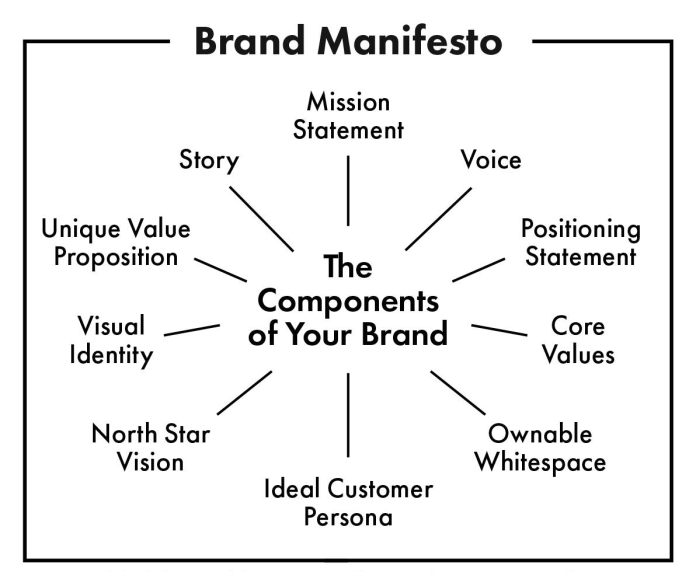
Your Brand Manifesto is a living, breathing declaration of how your business will show up in the world. It connects your big-picture vision with the on-the-ground actions that drive measurable growth. It’s not just what you say, it’s what you believe, how you behave and what your customers experience across every touchpoint. When all 10 components come together, you create a brand that aligns your team, attracts the right customers and builds unstoppable momentum.
If 2026 is the year you decide to stop blending in and start standing apart, you need a Brand Manifesto.
Here are the 10 essential components every successful Brand Manifesto needs and why each one matters more than ever for businesses looking to accelerate growth.
- Ideal Customer Persona
Your ideal customer persona is an archetype of the customer you want to attract the most. Personas are powerful tools to elevate your business out of the echo chamber — they bring your customers to life and make them real. Robust personas go beyond surface-level demographics to articulate motivations, desires, attitudes and behaviors. When done right, they become a powerful, shareable asset that helps your entire organization understand who you’re serving, what they care about most, and why they choose you over anyone else.
- North Star Vision
Your North Star Vision gives your team and your customers something to believe in. It is the ultimate destination — your purpose — the change you want to make in the world. It’s big, bold and should almost feel scary (but in a good way). Vision statements often live in someone’s head — once you get it out and share it with your organization, your North Star vision becomes a rally cry.
- Mission Statement
Your mission statement is your driving force. It is inspiring, energizes your team and guides your day-to-day actions. It answers the question, “What are we here to do every day that gets us closer to our North Star Vision?”
Nike’s Mission statement is a great example: “To bring inspiration and innovation to every athlete in the world.” Then they add a powerful clarifier: “If you have a body, you are an athlete.” That single line does a lot of heavy lifting. It’s inclusive, empowering and unmistakably aligned with their brand ethos. It doesn’t talk about shoes or gear; it speaks to people on a deeper emotional level.
If your team can’t recite your mission and explain how their work contributes to it, then you don’t have one.
- Your Core Values
Core values aren’t just words in a company handbook or slides in an all-hands meeting. They are the beliefs that work together
as important guardrails for your business. They drive hiring, firing, decision-making and brand behavior. They tell your team how to act and your customers what to expect. When done right, your core values build trust and deepen emotional connections. Core values guide how you walk the talk.
- Your Ownable Whitespace
In a noisy, crowded market, you might have the best [insert product or service], but if you look or sound like your competition, you’re lost in the dreaded Sea of Sameness.
Unrivaled companies claim the unique space — I call it the ownable whitespace — that sets them apart. Your ownable whitespace is at the intersection of what your customers value most and what you do best, without overlapping into what your competitors do best. It takes you from being just one more player in a category to creating your own.
- Your Unique Value Proposition (UVP)
The biggest opportunity to optimize your go-to-market execution starts with your UVP. I see over and over, especially with B2B companies, that they’re missing a UVP. Your UVP is a short, powerful articulation of your ownable whitespace. A strong UVP speaks to your audience in words that resonate and motivate. It makes your ideal customer nod their head and think, “Yes, tell me more!”
- Your Positioning Statement
Your positioning statement is your elevator pitch. It’s a clear, concise statement of two to four sentences that explains “why you?” and causes your ideal customer to say, “That’s interesting” or “Sounds like what I need/want.” It is jargon-free and efficiently tells your audience what makes your business different. It connects your internal strategy to your external message. Your positioning statement is the consistent thread through all of your go-to-market tactics, ensuring that you are tying everything back to why you are the obvious choice for your ideal customer.
- Your Brand Story
People remember stories 20 times more than facts alone. Your brand story is not a history lesson. It’s a way to let everyone in on your origin story — Why does your business exist? What problems are you trying to solve? It incorporates your vision, mission, and core values into a clear, authentic narrative that creates a powerful emotional connection for everyone who interacts with your company. Give them the feels — the best brand stories make us feel (and remember) something.
- Your Brand Voice
Every brand has a voice — you just need to define it. Think of your brand voice as your personality. Are you playful or serious? Confident or curious? Trader Joe’s is a great example of a brand with a unique voice. It’s different from other grocery brands.
It’s quirky and fun, direct and personal. Their tone resonates with their ideal customer (aka me!). Even their employee titles ladder to their voice: captain and first mate, not manager and assistant manager. Take a look at how your brand shows up to the world. A consistent, unique, customer-obsessed voice sets you apart from competitors and speaks to your target audience in words that matter to them.
- Your Visual Identity
In my book, I talk about how so many companies start by creating their visual identity, but they haven’t done the deeper strategic work to define their brand strategy components, like items 1-9 above. Your visual identity is more than just a logo. It’s the complete system, the color palette, typography, iconography and imagery that expresses your business ethos and ownable whitespace. It is strategic and made up of thoughtful, purposeful decisions about what your brand looks like and feels like to your ideal customer. It becomes a calling card that helps you stand out, be recognized, connect emotionally and build consistency across all touchpoints. The most successful brands use their visual identity as a system that consistently guides how they show up.
Ready to Build Yours?
If you’re thinking, “We have some of this already,” great! Is it communicated clearly to your entire team? A successful Brand Manifesto creates alignment across your entire organization. It puts all the pieces together so your brand delivers one cohesive, confident, unforgettable experience, both internally and externally.
A recent Harvard study found it takes an average of seven impressions for a customer to remember a brand. But if each of those touchpoints tells a different story, uses a different tone or feels like a different company, you’ve wasted all seven. Consistency isn’t boring. It builds trust. And trust builds growth.
Unrivaled companies use their Brand Manifesto to:
- Align teams around a shared
- Accelerate decision-making.
- Improve customer
- Elevate sales
- Drive culture from the inside
When done right, your Brand Manifesto becomes the most valuable internal asset you own. It’s not locked in a strategy doc or buried in brand guidelines. It’s the strategy your entire company commits to — you run every decision through its powerful framework. It’s the “why” behind your “what.” It helps your people know what to say, how to say it, and why it matters. And it’s the first step toward becoming Unrivaled.
If your 2026 goals include running a more efficient and effective go-to-market strategy, start with your Brand Manifesto. Build it. Align to it. Live it. And let the competition wonder how you made it look so easy.