
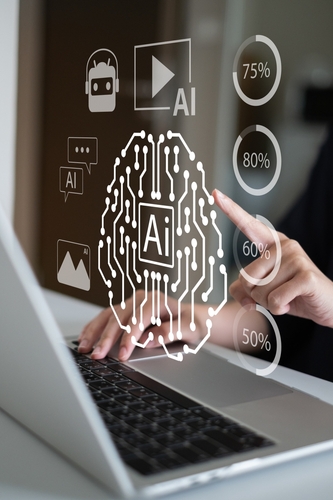
Marketing is psychology. AI didn’t change it. AI enhanced it. When algorithms absorb emotional sentiment and predict emotional desire to create the perfect message, the perfect pitch, it only makes sense that in a world where automation becomes increasingly adopted, it’s the brands that predict and rely upon the psychology of how and why such automation works that will thrive.
It’s not what AI gives us. It’s how we respond to what AI gives us.
The Persuasive Power Behind AI
AI is behind the metaphorical, invisible curtain of marketing persuasion. It feels behavior and will consistently lead a consumer to least resistant, personalized experiences and coded persuasive techniques in real time, unbeknownst to a consumer – and behind a metaphorical thin veil – they merely feel as if they’re living in the brand’s world.
But it’s that world that persuades. It’s that world that generates loyalty. And loyalty is persuasive.
AI isn’t giving consumers what they want. AI is giving them what they want back to themselves.
The Personalization Paradox
Thus, welcome to the personalization paradox; the more personal companies want to be with consumers, the more they rely upon AI to be their substitute.
Why is personalization so potent? Because it triggers three bases of psychological appeal:
- Validation – “They get me.”
- Relevance – “This makes sense for me.”
- Effortlessness – “This is easy for me.”
Therefore, at scale when AI presents the perfect product at the perfect time with the perfect message it feels instinctual. But, at scale, it’s algorithmic.
Where does it go too far? It’s creepy when it lacks empathy.
Where does it operate comfortably within the Inverted-U Relationship? When it makes people feel good, not exploited.
Social Proof in the Digital Age: UGC Is Psychological Currency
User-generated content (UGC) has long served as a potent influencer, and AI only makes access to it easier. It curates the best reviews, allows the most popular voices to rise to the surface, and archives the most relatable tales.
UGC works because it appeals to…
- Social identity
- Belonging
- FOMO (fear of missing out)
- Social validation
- Emotional contagion
People don’t trust brands when they say they’re trustworthy. They trust humans who are trustworthy.
Thus, AI-fed UGC often surpasses even advertising because it appeals to psychological shortcuts, something no one realizes is a shortcut but feels organic and natural.
Influencers: Persuasive Humans AI Cannot Create But Can Exploit
Influencers are human made. AI makes them unavoidable. Machine learning determines who gets noticed, whose communication is most poignant for consumer populations, and which personality gets directed toward which segments.
The psychological associations are similar:
- Parasocial relationship
- Credibility
- Aspirational lifestyle
- Relatability
- Consistency
AI merely weaponizes these associations on a larger, more powerful scale. Therefore, brands can influence what emotional substance is communicated through those already influencing such emotional substance.
Attention Is the Most Finite Resource
In a distracted world, there’s no greater commodity than attention. AI is built to win it.
AI-enhanced marketing relies upon an established basis of psychological appeals:
- Novelty
- Surprise
- Emotional variation
- Visual prominence
- Pattern recognition
- Timing accuracy
Brands can position micro-moments to resonate because they always have something to say.
AI can assist brands in figuring out when customers are most likely to scroll, buy or otherwise bypass. That manipulation of timing is psychologically valuable.
Good Judgment: The Only Human Skill AI Cannot Replace
AI generates options. Humans generate meaning.
It’s the difference between good brands and forgettable brands – good judgment – the uniquely human ability to make sense of signals, recognize nuances and create experiences that just feel human.
AI can…
- Assess behavior
- Audience segments
- Sentiment analysis
- Campaign improvement
- But only humans can make sense of what’s…
- Socially appropriate
- Ethically appropriate
- Culturally appropriate
- Emotionally appropriate
Human judgment will be the ultimate competitive moat.
The Future: Hybrid Persuasion
The next evolution of marketing is born from AI precision combined with human psychological insight. Brands that rely on automation will feel too mechanical; brands that fail to integrate AI will feel obsolete.
The best formula is this:
AI identifies insights → Humans craft the narrative → AI distributes at scale → Humans iterate with empathy.
That dynamic creates persuasive effort that feels personal, intentional and trustworthy.
The Real Question Facing Marketers Now
AI is no longer a luxury. However, the real question is not about technology, but about experience.
Those brands that come out on top will be those that harness the power of AI to make their consumers feel empowered, recognized and part of something bigger.
It’s not the algorithms that seal the deal. It’s the emotions.